The Association for Sustainable Development Slatina (ADDS)
has launched ALMA Network by ADDS, an open European community that brings
together organisations, host institutions, employers and young people in
Romania around a shared goal: turning transnational mobility into real pathways
towards work, education and inclusion.
For a young person who has left school early, struggled to
find a first job, experienced repeated setbacks in employment or gradually lost
confidence in their ability to find a place in the labour market, the distance
to meaningful opportunities is rarely only about skills or qualifications. It
may also reflect discouragement, unsuccessful attempts to enter or remain in
employment, limited access to guidance, difficult personal circumstances or the
absence of an environment in which they can rediscover their abilities and
potential. For many young people in Romania, the challenge is not simply
finding an opportunity, but regaining the confidence, motivation and support
needed to pursue one.
Across Europe, there are organisations ready to help create
such opportunities. Youth workers, training providers, social enterprises and
employers in other countries are looking for partners with whom to welcome,
mentor and support young people from abroad. Very often, however, the two sides
never meet.
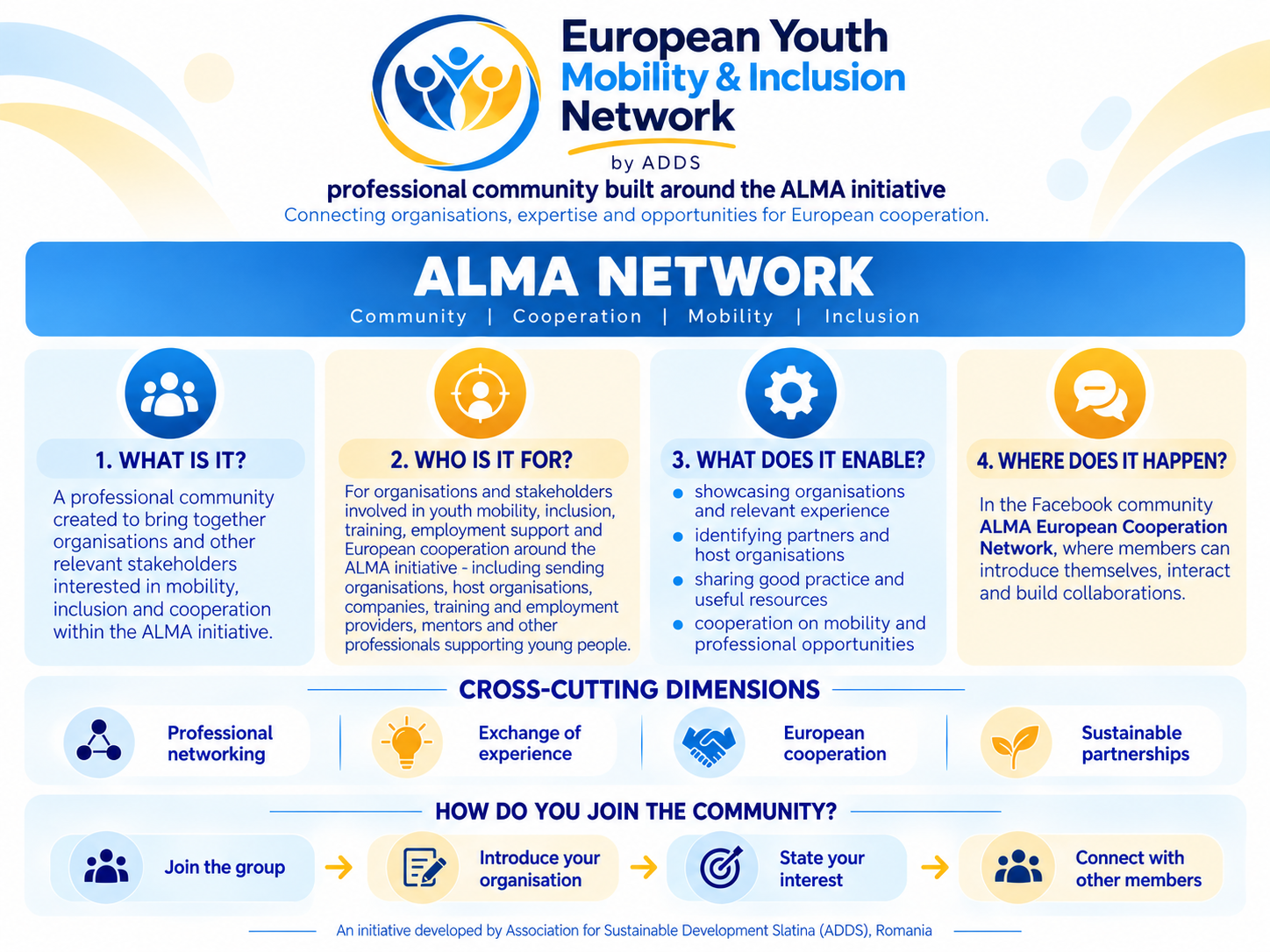
ALMA Network by ADDS was created to change that. It is a space where those who build opportunities, those who host them and those who need them can find each other, talk and start working together.
A challenge Romania cannot ignore
Romania continues to have the highest share of young people
not in employment, education or training (NEETs) in the European Union.
According to Eurostat data for 2025, 19.2% of young
people aged 15 to 29 in Romania were neither working nor participating in
education or training, compared with an EU average of 11.0%. In practical
terms, almost one in five young Romanians in this age group remains
disconnected from both the labour market and educational opportunities.
The situation reflects a persistent structural challenge.
While the European Union has made substantial progress over the past decade,
reducing its average NEET rate from 15.2% in 2015 to 11.0% in 2025, Romania
continues to experience significantly higher levels of youth exclusion. Despite
a slight improvement compared with 2024, when the national NEET rate stood at
19.4%, the gap remains substantial.
National averages also hide deep territorial and social
inequalities. Regional analyses based on 2024 data reveal significant
differences between major urban centres and less developed areas, including
parts of southern Romania. Young women, young people with low levels of
education and those living in disadvantaged communities face particular
barriers to entering employment or continuing education.
Past experience points to a clear lesson: funding is
necessary, but not sufficient. Significant European resources have been
invested in youth employment in Romania, yet structural barriers to inclusion
remain. Reaching young people who are disconnected from existing support
systems and accompanying them throughout their transition towards employment or
education requires more than isolated interventions.
What makes the difference is the quality and continuity of support: personalised guidance, real work experience, mentoring, opportunities to rebuild confidence and develop practical skills, and follow-up over time.
ALMA: a European answer built on mobility
ALMA (Aim, Learn, Master, Achieve) is an initiative
of the European Commission, supported through the European Social Fund Plus
(ESF+), designed to promote the active inclusion of disadvantaged young people
who are not in employment, education or training.
The ALMA model is built around three connected stages:
- Preparation at home. Participants receive
personalised guidance, coaching, training and support in their own
country, helping them develop the skills, motivation and readiness needed
to benefit from an international learning experience.
- A supervised learning experience
abroad. Young people spend a period, typically between two and six
months, in another EU Member State, undertaking work-related learning
placements in companies or other organisations. These experiences are
facilitated through cooperation with host organisations and accompanied by
mentoring, guidance and practical support.
- Follow-up after return. Back home, participants
receive continued assistance in using their newly acquired skills and
experience to take the next step towards employment, an apprenticeship,
further training or a return to education.
What distinguishes ALMA from other mobility schemes is its
focus on young people who often remain outside traditional international
opportunities: those with insufficient qualifications, limited resources,
disabilities, long periods of unemployment or other circumstances that make
access to work and education particularly difficult.
For them, a structured experience abroad can build
practical skills, self-confidence, autonomy and intercultural understanding,
and above all a clearer picture of what their future could look like.
ALMA is therefore not simply about mobility. It is about using mobility as an instrument for inclusion, learning and sustainable personal and professional development.
The Missing Link: Partnerships
The potential of ALMA depends not only on available funding
but on something less visible: the ability of organisations in different
countries to find each other, trust each other and work together.
An ALMA mobility cannot happen without a chain of partners.A
sending organisation must identify, prepare and accompany young people. A host
organisation in another country must help identify and organise suitable
work-based learning placements, cooperate with local employers and
institutions, facilitate appropriate living arrangements and ensure that
participants receive mentoring, guidance and practical support throughout their
stay. Mentors, employers, training providers and other relevant stakeholders
must work together, with a shared understanding of objectives, roles,
responsibilities and quality standards.
In practice, building such a chain is often one of the most
demanding parts of developing a successful transnational initiative. Smaller
organisations, especially those working closest to vulnerable young people,
frequently lack international contacts, information about funding opportunities
or the resources needed to identify reliable partners. At the same time,
potential host organisations, employers and professional networks may be
willing to contribute to mobility experiences but may not know where to find
appropriate cooperation partners or how to become involved.
The result is a paradox: the need exists, the
willingness to cooperate exists and European instruments exist, but the
connections that would turn them into concrete projects are often missing.
ALMA Network by ADDS was designed precisely to help bridge this gap.
About ADDS
The Association for Sustainable Development Slatina (Asociația
pentru Dezvoltare Durabilă Slatina – ADDS) is a non-governmental,
non-political and non-profit organisation with more than two decades of
experience in designing and implementing initiatives for people, organisations
and communities.
Its work is based on an integrated vision of sustainable
development, bringing together economic, social, cultural and environmental
dimensions. ADDS aims to unlock human potential, strengthen organisational
capacity and create real development opportunities.
The association works with individuals, employers, civil
society organisations, public institutions and other stakeholders to turn
identified needs into concrete programmes, projects and interventions, adapted
to changes in society and the labour market. Drawing on its longstanding
experience in community development, skills development, project implementation
and institutional cooperation, ADDS promotes approaches that connect individual
opportunities with organisational capacity, social inclusion and sustainable
community development.
This experience provides the foundation for the organisation's involvement in developing new European cooperation frameworks and initiatives aimed at expanding access to learning, mobility and professional opportunities.
Why ADDS Started the Network
Drawing on its longstanding experience in community
development, skills development and cooperation with diverse stakeholders, ADDS
recognises the importance of connecting organisations that can create
opportunities with people who need access to them. ALMA Network by ADDS was
launched to connect these two realities.
Within the network, ADDS acts as initiator and facilitator.
It identifies and invites relevant European stakeholders, encourages the
exchange of information and good practices, supports the development of
transnational partnerships and raises awareness among young people in Romania
about European mobility opportunities. In parallel, ADDS is developing
cooperation frameworks and project proposals aligned with the European ALMA
initiative, focusing on personalised support, work-based learning, mentoring,
skills development and sustainable pathways towards employment and education.
The network reflects a conviction at the heart of ADDS's work: European cooperation is not an abstract concept, but a practical instrument for expanding opportunities for people and communities facing barriers to participation.
More Than a Social Media Group
The community currently meets in a dedicated Facebook
group, chosen as an accessible and familiar communication platform for
organisations, professionals and young people. But the group is the meeting
point of a broader cooperation initiative, not the initiative itself.
Within the group, members can introduce their organisations
and professional interests, share information about ALMA and other relevant
European opportunities, identify potential cooperation partners, exchange
resources and good practices, and engage in discussions with others working in
similar fields. The group is intended to encourage direct communication and
make it easier for interested organisations and individuals to establish
initial contacts.
As the community develops, ADDS aims to encourage connections that may lead to more structured cooperation, including joint project ideas, transnational partnerships and mobility opportunities for young people. Depending on the interests and contributions of its members, the network may also provide a framework for thematic exchanges, online meetings, sharing practical resources and facilitating contacts between sending and host organisations.
ALMA Network by ADDS is conceived as an evolving community in which information can become dialogue, dialogue can become cooperation, and cooperation can generate new opportunities.
An Open Invitation
Behind every statistic there is a young person whose
potential is still waiting for the right opportunity. Such opportunities emerge
when people and organisations are able to connect across geographical,
institutional and professional boundaries.
Whether you represent an organisation looking for transnational partners, a host organisation interested in supporting mobility placements, an employer willing to contribute to work-based learning, or you are a young person curious about what Europe can offer, ALMA Network by ADDS is open to you.
Join ALMA Network by ADDS and help build bridges between young people in Romania and opportunities across Europe.
Join our Facebook community:
https://www.facebook.com/groups/1643720934065280
Contact ADDS:
alma.network.adds@gmail.com

Ramona Andreea Georgescu
ALMA Transnational Officer
Association for Sustainable Development Slatina (ADDS)

ALMA Network by ADDS is an independent networking and cooperation initiative created by the Association for Sustainable Development Slatina (ADDS) in the context of the European ALMA initiative. It is not an official European Commission network. Participation in the community does not automatically guarantee access to funded mobility programmes.
Sources and Further
Information
- Eurostat (2026) – Fewer young
people not in work or education in 2025.
https://ec.europa.eu/eurostat/en/web/products-eurostat-news/w/ddn-20260528-2 - Eurostat – Young persons
neither in employment nor in education and training by labour status (NEET
rates), dataset edat_lfse_20.
https://ec.europa.eu/eurostat/databrowser/view/edat_lfse_20/default/table - European Commission – ALMA: An active
inclusion initiative for young people.
https://employment-social-affairs.ec.europa.eu/policies-and-activities/skills-and-qualifications/alma-active-inclusion-initiative-young-people_en - European Commission – ALMA Handbook.
https://european-social-fund-plus.ec.europa.eu/system/files/2024-02/ALMA%20Handbook.pdf